In this article
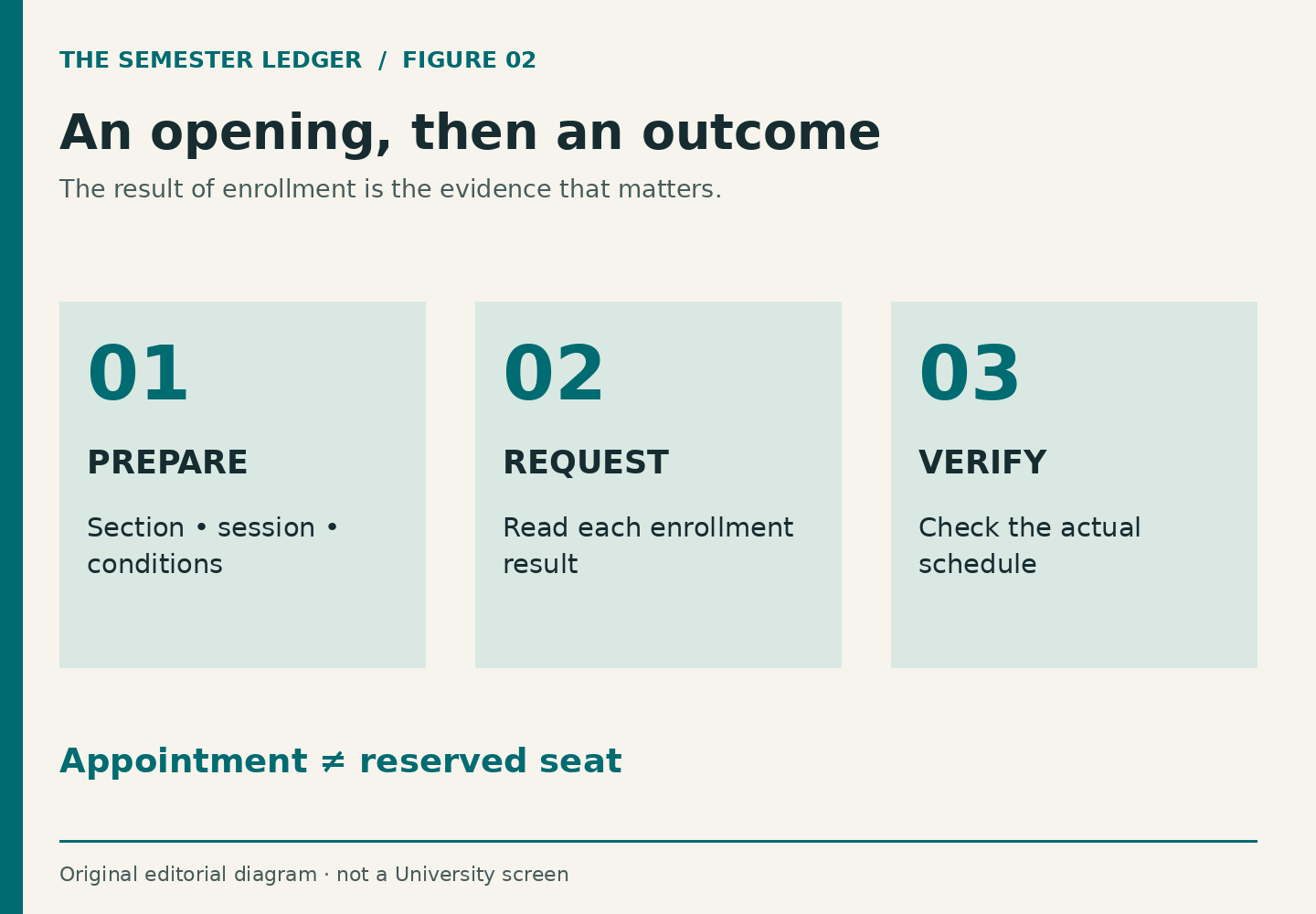
A registration appointment is the beginning of an opportunity to enroll, not a reservation of the classes in your cart. Treating it as a guaranteed schedule can leave a student surprised by a full section, a hold or an unmet condition. The better preparation is to separate the opening time from the readiness of each course request.
The University of Utah’s registration-date guidance explains where students can view their assigned date in CIS. It also explains that continuing undergraduate assignments depend on class level and completed credit, with students assigned in groups. Two students with similar academic standing can therefore see different dates. Your own current assignment is the relevant record, not a friend’s screenshot or an old semester’s calendar.
Official context: Registrar: Registration Dates, Registrar: How to Register for Classes.
Identify the student pathway first
New students and continuing students do not necessarily follow the same preparation route. The Registrar notes that freshmen and transfer students register as part of orientation, while returning and continuing students receive assigned registration dates. If you are returning after time away, do not assume that the phrase “returning student” settles your admission or enrollment status. Establish which process applies to your actual situation through the University.
Write the term beside the assignment. Registration planning can involve the current semester and a future semester at the same time, especially in the fall. An appointment displayed for one term should not be used to explain an error in another. This small naming habit is particularly useful when an office asks which schedule you were trying to change.
Prepare a course request rather than a course wish
A useful planned entry includes the subject, catalog number, section, session and credit value. It also notes the requirement the course is intended to fulfill. “Take biology” is a goal; “evaluate this section against this requirement and this meeting pattern” is a request that can be checked. The extra specificity helps distinguish similarly named courses and sections that meet in different parts of the semester.
Check the public class information before the appointment. Read notes, meeting pattern, modality and any linked components. If a lecture requires a particular discussion or lab arrangement, a schedule that considers only the lecture can be incomplete. Do not infer that two sections are interchangeable because their course titles match. The class identifier is the coordinate that keeps your plan attached to the actual offering.
Resolve known conditions before the opening time
Use the University’s registration checklist and the Tasks area to identify conditions that need attention. A hold is not merely an inconvenience to click past. Its reason and issuing office determine the next step. If you have submitted material to resolve it, verify whether the condition has actually changed rather than assuming that submission immediately removes it.
Similarly, an expected prerequisite result is not always the same as a recognized prerequisite in the registration record. Transfer work, recent grades or an unusual course history may require clarification. Ask the appropriate academic or registration office while there is time to investigate. Avoid sending a broad packet of private records to multiple recipients when a narrow question can first establish what evidence is needed.
Build alternatives around academic purpose
An alternative should answer the same planning need where possible. If the first choice satisfies a requirement needed for a later sequence, a random elective at the same time is not necessarily a meaningful substitute. Identify the constraint that matters most: progression, required credit, timing, location or a particular learning goal. An advisor can help evaluate academic substitutions; this publication cannot approve them.
Consider a fictional student who needs a course before taking a later class. The primary section conflicts with work, a second section fits but is full, and a third course is merely interesting. The useful backup discussion concerns the sequence and available sections, not just filling the empty space on a weekly grid. A complete schedule and a workable academic plan are related but distinct outcomes.
Understand credit limits without designing around them
The Registrar’s reviewed registration-date page states different credit limits for undergraduates during appointment and open-enrollment periods, and a separate graduate limit with an approval process for going beyond it. Check the current page for the figures and procedure that apply. These are official enrollment constraints, not recommendations about how much work an individual should take.
Do not build a strategy around repeatedly attempting a load the system does not permit. If your plan genuinely requires an exception, ask about the authorized process early. Also assess the real weekly workload independently of the maximum. A short-session class can concentrate effort even when its credit number looks modest. Permission to carry a load does not establish that it fits your other responsibilities.
Read the result course by course
After submitting enrollment requests, inspect each result and then the resulting schedule. A mixed outcome is possible: one request may succeed while another needs attention. Do not use the success of the first row as proof that the entire plan completed. Record the exact course and observed status for any unresolved request, without translating an unfamiliar message into a conclusion it does not state.
If a section is waitlisted, place it in a separate category from enrolled courses. If a message refers to reserved seats, a general empty-seat count may not explain your eligibility. If it refers to consent, identify which department or instructor controls that consent. The words in the response should direct the next question, rather than triggering a generic search for a different login link.
Protect your place while assessing a change
Before dropping a confirmed class to pursue another, understand the official swap process and its limits. A proposed replacement can carry conditions you did not anticipate. The Registrar provides a swap tutorial through its registration instructions. Follow the current official procedure and inspect its result; this article does not promise that every proposed exchange will succeed or preserve an existing arrangement.
The practical principle is to make one deliberate change with a clear before-and-after check. A series of hurried drops, adds and repeated submissions can make it difficult to determine which action produced the current schedule. When uncertainty appears, stop long enough to read the record and seek official help. Do not assume that a browser back button reverses an enrollment transaction.
Finish with a confirmed plan and an open-question list
At the end of the session, separate confirmed classes, waitlisted possibilities and unresolved errors. Review the total credits, actual meeting pattern and session dates. Then revisit the academic purpose of each course. This final pass is where a technically successful enrollment can still reveal a planning problem, such as two courses that solve the same elective need while leaving another requirement unaddressed.
Keep the next action small and assigned: ask an advisor about a requirement, ask a department about a particular restriction, or check an official result after a submitted correction. An appointment is most useful when it begins a prepared process rather than a rush. The aim is not merely to act at the earliest possible moment; it is to know exactly what the action accomplished and what remains unsettled.
Sources and editorial scope
Public University sources reviewed October 15, 2026. Procedures, dates and individual eligibility can change. The planning methods and hypothetical examples are original editorial analysis. No private account was accessed; this publication cannot decide academic, financial-aid or tuition outcomes.
- Registrar: Registration Dates — Assigned registration dates, student pathways and published load-limit context.
- Registrar: How to Register for Classes — Official navigation to task-specific registration tutorials; no claim of tested current interface.