In this article
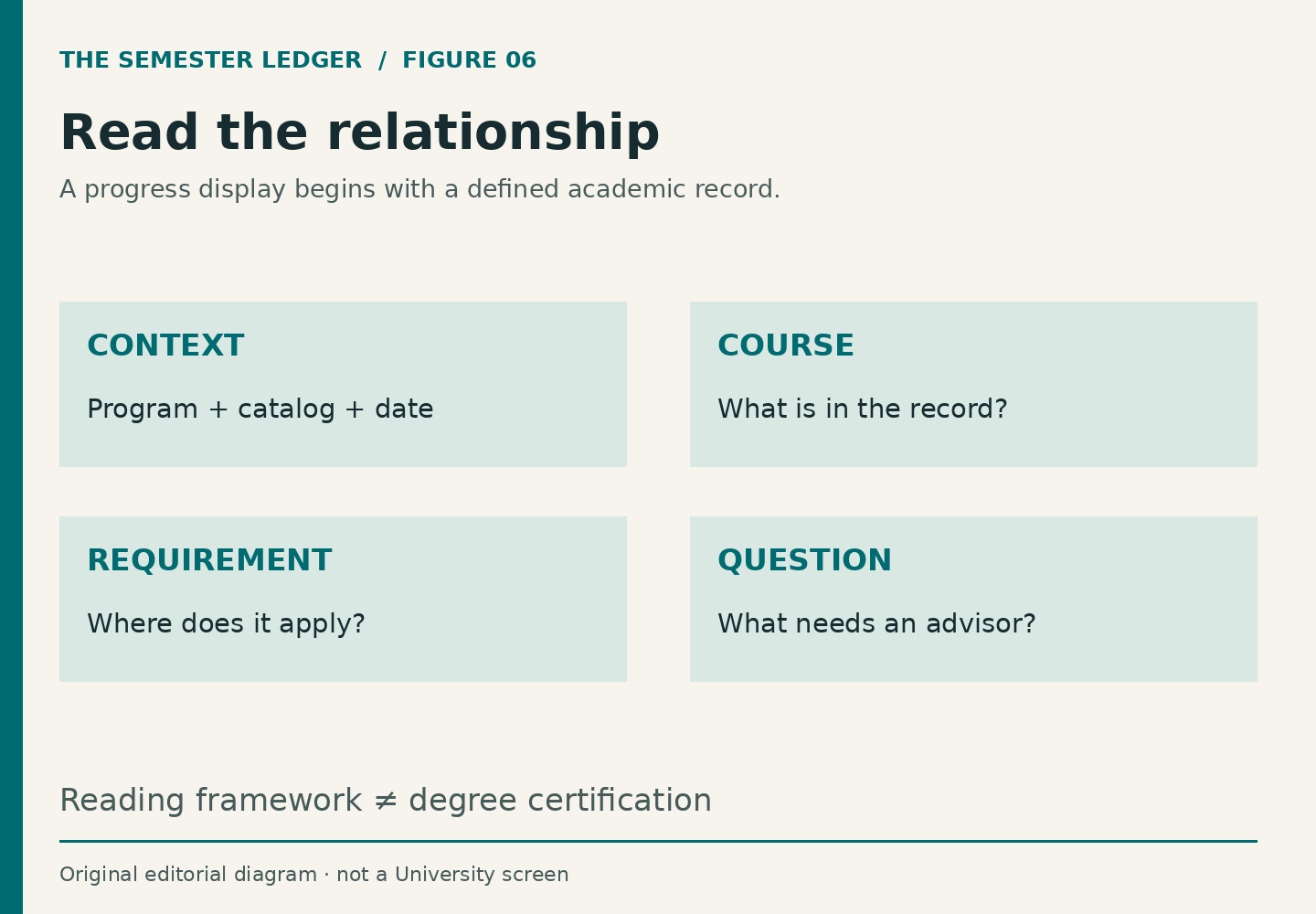
A degree audit is most useful when read as a report about a defined program and record, not as a single progress percentage. The University of Utah describes it as an automated comparison of completed courses with program requirements, including requirements still to be satisfied. Before interpreting a result, establish which program, catalog year and version of the academic record the report represents.
This is a student reading guide, not a graduation certification service. It helps you prepare an advisor conversation and distinguish a missing fact from a misunderstood requirement. It does not approve substitutions, enter exceptions or predict a final graduation decision. Your official academic advisor and the Registrar remain the relevant sources for record-specific questions.
Official context: Registrar: Degree Audit and Graduation, Registrar: Undergraduate Advisor Graduation FAQs.
Read the report’s identity before its conclusions
Start with the declared major, degree type, minor or emphasis where applicable, catalog year and report date. A report generated for an exploratory program can be useful, but it should not be mistaken for the audit of your current declared program. Label exploratory work clearly in your own notes so that it does not quietly replace the actual graduation plan.
The Registrar’s advisor guidance emphasizes using the correct catalog information and distinguishes declared-program audits from analyses of other programs. For a student, the practical question is simple: does this report describe the academic plan I intend to complete? If not, resolve that mismatch before treating every unmet requirement as a problem in your coursework.
Distinguish missing coursework from missing information
An unmet line can reflect different questions. The course may not have been taken, the work may not yet be posted, or its application may require an official explanation. Do not collapse those possibilities into “the audit is wrong.” Identify what evidence exists and which relationship remains unclear. That creates a specific issue for the advisor to investigate.
For a fictional transfer student, a course may appear in an earlier institution’s record while the Utah audit does not yet show the expected application. The student should first establish whether the relevant work is present in the Utah record, then ask how it applies. Those are separate questions. Sending the same transcript repeatedly without identifying the missing stage may not address the actual issue.
Follow a course to its requirement
Choose one course you expected to satisfy one requirement and trace where the report places it. Preserve the course identifier, term and requirement wording. If it appears elsewhere, ask whether that placement is correct and what remains for the intended requirement. A course can contribute academically without resolving the particular requirement you had in mind.
An invented example is a course counted among general electives when the student expected it to satisfy a major requirement. The student’s next action should be a focused academic question, not an attempt to edit the audit. The advisor can explain the requirement or identify an authorized correction or exception process if one is applicable. This publication cannot determine the course’s proper placement.
Keep completed, in-progress and planned work distinct
A report may incorporate information about ongoing coursework or planning. Read its actual legend and status labels. An intended future course is not completed work, and an enrolled course is not yet a final result. A plan that depends on successful completion should retain that condition rather than describing the requirement as permanently settled.
This distinction becomes important after a schedule change, a grading-option decision or a course outcome. Revisit the affected requirement rather than assuming the earlier audit remains a complete description. Keep the report date with your notes. Two reports can differ because the underlying record changed, not because one of them is inherently less reliable.
Build a short advisor agenda
Bring a small set of bounded questions: one requirement whose wording is unclear, one course whose placement is unexpected, or one remaining sequence you need to plan. State the academic goal and the evidence you can see. A long list of screenshots without named questions can make an appointment less effective even when all the information is technically present.
Prioritize questions with consequences for the next registration period or intended graduation term. Ask what action you should take, who owns any correction and how you will know the matter is resolved. If the answer involves another department, record that referral accurately. Do not treat an informal possibility as an approved exception or promise that the record will change automatically.
Treat exceptions as decisions that must be reflected
If an authorized academic office approves an exception, ask how it will appear in the official audit and what follow-up is appropriate. Keep the approval in the University’s proper channel. A private note that an advisor discussed a possibility is not the same as a recorded approval, and an approval is not necessarily the same as a completed system update.
After the expected process, generate or inspect the appropriate current report and check the specific requirement. If it still appears unresolved, ask a focused follow-up naming the approved item and observed result. Avoid circulating private academic records outside the official process. The purpose is to reconcile the decision and the record, not to collect unofficial opinions about the same requirement.
Expect interface changes without assuming policy changes
The University’s Degree Audit and Graduation page links to a system-upgrade project. A modernization announcement does not establish that a particular new interface is available to every student or that degree requirements have changed. Use the current official route and help materials. If a screen name differs from an older tutorial, seek current guidance rather than treating the old screenshot as a fixed specification.
During any transition, keep the academic question stable: which program, requirement, course and recorded decision are involved? Those identifiers are more useful than a description of where a button used to appear. If two current official views appear inconsistent, ask the University which view should govern your planning. This publication does not resolve discrepancies in private systems.
Use the audit as preparation for the next decision
Before registration, use the audit to identify the purpose of proposed courses. Before graduation, use it to organize the remaining requirements and questions for the official review. After a change, use it to verify the affected relationship. These are different reading moments; the same report should not be expected to answer every question forever.
The useful endpoint is a clear plan with named conditions. You know which requirements are satisfied in the current record, which depend on ongoing work and which need an official answer. That is stronger than an optimistic interpretation of a progress display. A careful audit reading turns a complex report into a manageable academic conversation without claiming authority the report or this publication does not have.
Sources and editorial scope
Public University sources reviewed October 15, 2026. Procedures, dates and individual eligibility can change. The planning methods and hypothetical examples are original editorial analysis. No private account was accessed; this publication cannot decide academic, financial-aid or tuition outcomes.
- Registrar: Degree Audit and Graduation — Audit compares coursework with program requirements; links official modernization project without claiming universal launch.
- Registrar: Undergraduate Advisor Graduation FAQs — Declared-program and exploratory audits; catalog-year context only.