In this article
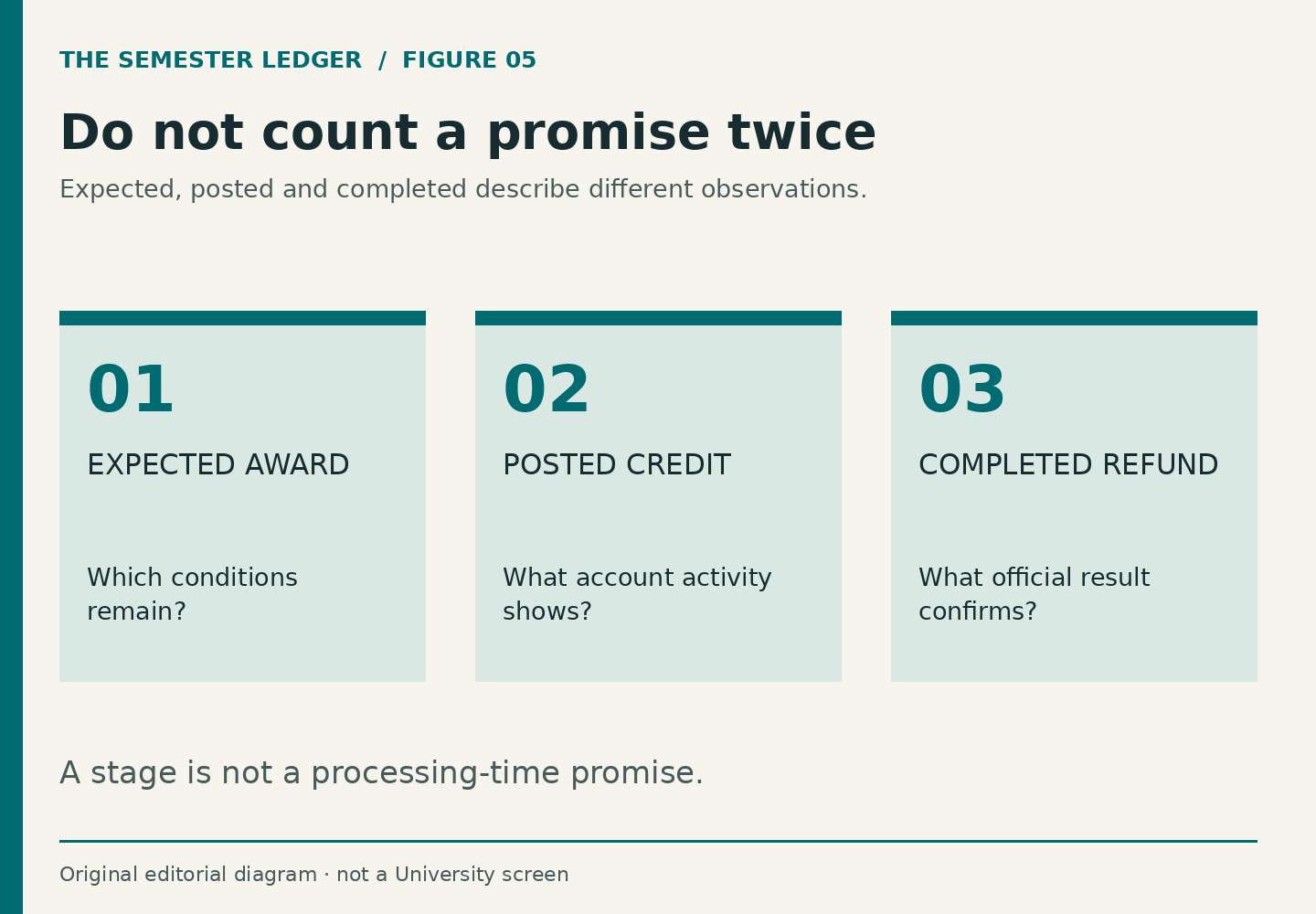
A tuition bill is easiest to misread when several different kinds of numbers are treated as money already available. A charge, an expected scholarship, an aid offer, a posted credit and a refund are not interchangeable entries. Before asking why the balance looks wrong, identify which record each number comes from and which stage it represents.
The University of Utah’s Financial Aid office directs students to review their tuition bill in CIS and emphasizes responsibility for timely payment. Its disbursement guidance distinguishes an aid offer from crediting the tuition account. This article uses that distinction to build a reading method. It does not calculate your bill, recommend borrowing or determine an individual payment obligation.
Official context: Financial Aid: Disbursement of Funds, Registrar: Find the Right Help.
Begin with the term and the snapshot
A balance belongs to a particular account view at a particular time. Record the term and the date you reviewed it before comparing it with another screen or a saved statement. An older statement and a current account view may reflect different activity. If the labels or coverage differ, do not assume that the larger number is newer or that the smaller number is the amount you should pay.
Read the headings around the total. Is the view showing a term, a transaction history, a payment-plan summary or another category? This publication does not assume a single current screen layout. The principle is to identify the scope of the displayed number using the University’s own labels, then ask the responsible office when that scope is unclear.
Give every amount one role
For a private reading exercise, sort visible entries into charges, posted credits and unresolved expectations. These are organizational categories, not a replacement for the account’s official terminology. Preserve the original label alongside your interpretation. If you cannot tell whether an entry is a charge or credit, mark it as a question rather than choosing whichever direction makes the balance look familiar.
An expected amount should remain outside a reconstruction of posted activity until the official account actually reflects it. Suppose a fictional account shows $4,000 in charges and $2,500 in posted credits, while a separate notice mentions an expected $1,000 award. The posted arithmetic gives $1,500 before considering any other entries. Calling the balance $500 would silently treat the expectation as a completed credit.
Check whether the comparison includes the same items
A tuition estimate and an actual bill answer different questions. An estimate helps explore a scenario using assumptions; a bill reflects the account’s assessed activity. A difference may deserve investigation, but the comparison should first identify what each figure includes. Course-specific charges, program distinctions, enrollment changes or an older term may matter depending on the actual account.
Do not invent an explanation merely because a difference resembles a familiar fee. Name the entries you can see and ask the Bursar to explain the ones you cannot reconcile. A useful inquiry identifies the term, the exact label and the comparison being made. “The amount is higher” becomes more actionable when the office knows higher than which official record or stated estimate.
Follow changes as changes, not new totals in isolation
If you add or remove a class, compare the account before and after the change using the same scope. List the entries that appeared, disappeared or changed. A final balance can remain similar even when several components move in opposite directions. Looking only at the total can hide a charge increase paired with a new credit, or a reversed credit paired with a reduced charge.
For an invented example, a $300 charge reduction and a $300 credit reduction leave the balance unchanged. That does not mean nothing happened. It means two changes offset each other arithmetically. Whether either change is appropriate requires the relevant office’s explanation. The reading method helps you identify the question without treating arithmetic as a ruling on tuition or aid policy.
Distinguish a payment attempt from a posted payment
When reviewing your own account, keep the stages of a payment separate: the action you initiated, the confirmation you received and the activity reflected in the account. A browser returning to a previous page is not enough to establish the outcome. If you are uncertain, use the official payment service’s instructions and contact route before initiating another transaction.
This publication does not accept payments, store bank details or provide a payment form. Do not enter card numbers, routing numbers or account information into its search field or local tools. A tuition question should be handled through the verified University service. If a message directs you to an unfamiliar payment destination, verify the instruction independently before providing information or money.
Keep payment-plan terms attached to the actual agreement
A payment plan can have its own enrollment conditions, schedule and charges. Do not infer current terms from an old screenshot, a different plan or another student’s arrangement. Review the current official offer and agreement for your situation. This edition does not quote a universal fee, assume that a plan is available to everyone or promise that enrollment resolves an existing hold.
For reading purposes, distinguish the account balance from the amount scheduled in a plan. Ask what the plan includes, how later account changes are handled and which action confirms enrollment. These are questions to resolve before relying on a schedule. A monthly number alone does not describe the entire commitment or establish that every charge on the account is covered.
Ask one bounded reconciliation question
A clear inquiry can say that a named posted credit is absent from a particular term view, or that two official views appear to cover different items. Include only the identifiers and documents the official office requests through its established channel. Avoid sending a full financial history to an independent publication or multiple unverified addresses merely to increase the chance of a response.
Keep the office’s explanation attached to the entry it addresses. If it explains one charge, do not assume it also explains every other difference. If a correction is approved, verify the resulting account activity and ask what remains due or pending through the official route. The distinction between an explanation, a promised correction and a reflected change keeps the record coherent.
Finish with facts and unresolved expectations
At the end of the reading, you should be able to distinguish the current official balance, the posted activity you understand and the items still awaiting explanation. Keep any due date tied to the current official instructions. An expectation of future aid should not be treated as an extension unless the responsible University office explicitly establishes the applicable arrangement.
The value of a careful bill review is not that it produces an unofficial replacement total. It reduces the chance of asking the wrong office the wrong question or counting the same money twice. Read the term, label the stage, compare like with like and let the official account owner resolve the obligation that remains.
Sources and editorial scope
Public University sources reviewed October 15, 2026. Procedures, dates and individual eligibility can change. The planning methods and hypothetical examples are original editorial analysis. No private account was accessed; this publication cannot decide academic, financial-aid or tuition outcomes.
- Financial Aid: Disbursement of Funds — Offer, eligibility, tuition-account credit and remaining balance distinctions; no individual payment promise.
- Registrar: Find the Right Help — Office responsibility and official contact routing.