In this article
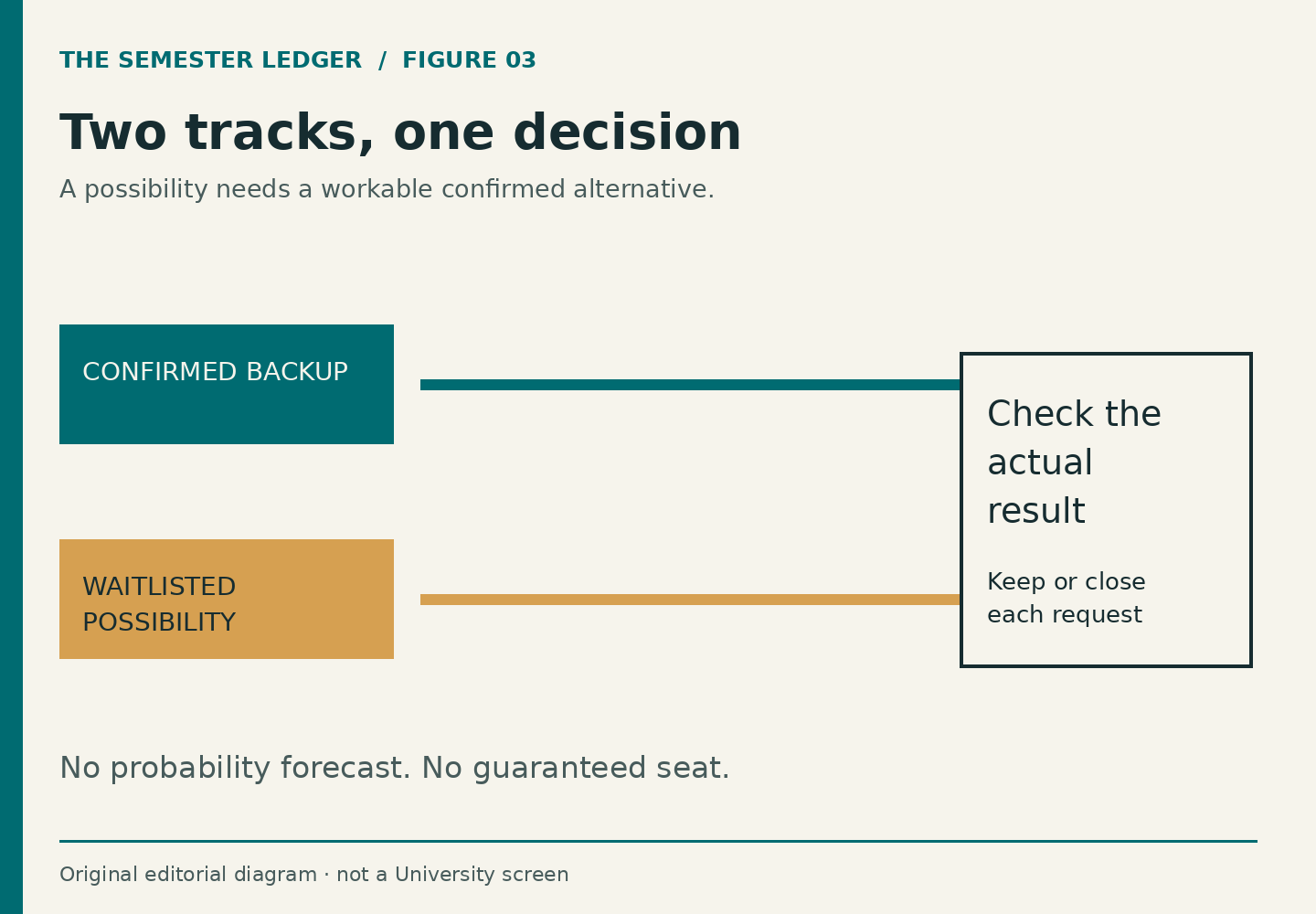
A waitlist position describes a possibility, not a confirmed seat. That difference matters when a course is central to a degree sequence, a work schedule or a minimum course load. A useful waitlist plan therefore has two parts: understand the conditions attached to the possibility, and maintain a viable plan that does not silently depend on it becoming enrollment.
The University of Utah’s waitlisting guidance explicitly says enrollment is not guaranteed. It also places responsibility on students to monitor whether they have been added, including UMail notifications, and to drop an unwanted class by the applicable deadline. Being on a list is not a passive state that can safely be forgotten after choosing a different schedule.
Official context: Registrar: Wait Listing, Registrar: How to Register for Classes.
Record the exact section and its role
Begin with the course and section you are waiting for. Note why it matters: a requirement, a sequence, a preferred time or an interest. These reasons lead to different backup decisions. If the course is simply a more convenient time, an enrolled alternative may already solve the academic need. If it unlocks a later course, the advisor conversation needs to address progression rather than convenience alone.
Keep the waitlisted section separate from enrolled sections in your private plan. Do not include it in a statement of confirmed credits, attendance obligations or financial-aid eligibility. Those determinations depend on the actual University record and applicable rules. A timetable that visually fills every hour can look complete even when one of its most important entries is still conditional.
Position is only one part of the story
A small position number is encouraging in an everyday sense, but it is not a probability calculation. The class may not lose a student, an available seat may carry a restriction, or an enrollment condition may remain unmet. An independent guide cannot convert the position into a reliable percentage chance. Do not make nonrefundable arrangements based on a guessed likelihood presented as a fact.
Instead, ask what information could change your decision. Perhaps another section becomes available, an advisor identifies a different sequence, or the department explains a restriction. Those are actionable developments. Refreshing a position repeatedly without a decision rule can consume attention while leaving the actual contingency unchanged. Decide privately when you will reassess the plan and which official deadline sets the outer limit.
Check conditions rather than treating the list as a shortcut
The Registrar’s guidance explains that students must meet applicable enrollment conditions. A place on a waitlist does not erase a prerequisite or make a conflicting plan academically workable. If an error message mentions a specific requirement, read that requirement and ask the responsible office what it means for the request. Do not assume the waitlist itself will resolve it later.
Credit load also deserves attention. A student with a full confirmed schedule may be hoping to replace a course rather than add another one. That intention must be represented through the appropriate official process. The system does not know your private plan merely because you remember which course you would drop. Follow the Registrar’s instructions for the situation and inspect the resulting request.
Consider a swap as a defined transaction
The University provides a swap workflow for situations where a student wants to keep an enrolled option while seeking another. Its waitlisting page discusses how that relationship can be established. Read the current official instructions rather than improvising a sequence of independent drops and adds. The point is to define the intended relationship between the existing enrollment and the desired replacement.
Before proceeding, write down the before and intended-after states. For example, a fictional student is enrolled in section A and wants section B only if that replacement can complete. After the action, verify which section remains enrolled and which is waitlisted. If the observed result differs from the intended relationship, ask for help promptly. A private note is a planning aid, not proof that the system stored your intention.
Keep the backup academically meaningful
A backup should be assessed against the need it is supposed to meet. Another three-credit course is not automatically equivalent to the desired three-credit course. Ask whether it fulfills the same requirement, changes the sequence, or simply provides an elective. This is especially important when future courses depend on completing a particular prerequisite in the current term.
Build alternatives around realistic constraints. A section that fits on paper but requires travel you cannot manage may not be viable. A compressed session may concentrate work differently from a full-semester course. A course at a different level may have its own prerequisites. The backup discussion should leave you with a plan you can actually carry out, rather than a list of names that merely reduces uncertainty temporarily.
Monitor the outcome through the official record
A notification is a reason to check the current schedule, not a substitute for understanding it. Confirm the course, section, session, credits and any accompanying components. If the class is now enrolled, revisit the rest of the schedule so that an old backup does not create an unintended extra load or conflict. An enrollment change can also prompt academic and financial questions beyond the waitlist itself.
If no notification appears, do not assume nothing changed. Use the official schedule as the record of current enrollment. Email filters, an overlooked message or a long interval between checks can make memory unreliable. This publication cannot monitor UMail or CIS for you, and its local planning tool has no access to either system. Establish your own check routine around the decision and relevant deadlines.
Remove possibilities you no longer want
A forgotten waitlist entry can become an unwanted enrollment. Once you have a final plan, review every remaining possibility and use the official process to remove those you no longer intend to take. Then verify the result. Closing an old browser tab or deleting a note from your calendar does not change the University’s enrollment record.
Treat the cleanup as part of the decision, not an optional housekeeping task. It is particularly important when several alternatives were assembled during a stressful registration period. The entry you no longer remember may still represent a live request. A final schedule review should therefore include both enrolled and waitlisted classes, with each remaining item having a clear purpose.
Set a stopping point for uncertainty
A good contingency has a point at which you seek another answer rather than continuing to hope. That point may come from a course deadline, an advisor’s planning guidance or a practical need to finalize work and travel. It is not a promise that a department can accelerate an enrollment decision. State the constraint honestly when asking for guidance.
The successful outcome is not necessarily the first-choice seat. It is a confirmed, workable plan and a clear understanding of any remaining condition. A waitlist can be useful without becoming a forecast. By separating possibility from enrollment and deliberately closing unwanted requests, you keep a changing registration process from quietly deciding your semester for you.
Sources and editorial scope
Public University sources reviewed October 15, 2026. Procedures, dates and individual eligibility can change. The planning methods and hypothetical examples are original editorial analysis. No private account was accessed; this publication cannot decide academic, financial-aid or tuition outcomes.
- Registrar: Wait Listing — Conditional enrollment, monitoring responsibility and swap context; no probability forecast.
- Registrar: How to Register for Classes — Official navigation to task-specific registration tutorials; no claim of tested current interface.